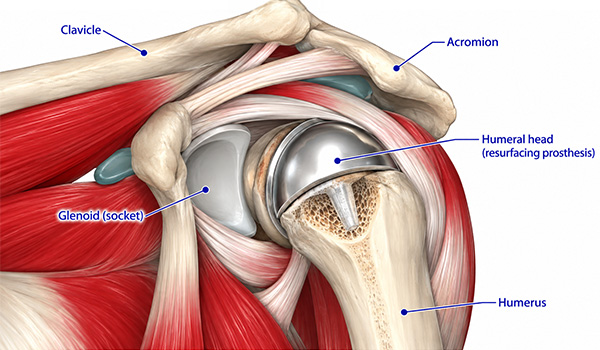
What is Shoulder Resurfacing Replacement?
The shoulder is a ball-and-socket joint that allows a wide range of movement. Arthritis can damage the smooth joint surfaces, causing pain, stiffness, weakness and difficulty with everyday activities.
Shoulder resurfacing in Edinburgh is a form of shoulder arthroplasty that replaces the damaged surface of the ball of the joint with a smooth metal cap. Unlike some forms of shoulder replacement, it may preserve more of the upper arm bone. At Fife Shoulder Surgery, I assess each patient individually to determine whether resurfacing, another type of shoulder replacement, or non-operative treatment is the best option.
What Does the Shoulder Resurfacing Operation Involve?
Before recommending Shoulder resurfacing in Edinburgh, I will review your symptoms, examination findings, X-rays and, where needed, further scans. I will explain the expected benefits, limitations and alternatives in your particular case.
The operation is carried out under anaesthetic. I make an incision around the shoulder, carefully access the joint and remove the damaged joint surface. The head of the upper arm bone is shaped and covered with a resurfacing implant. In some cases, the socket may also require treatment, or a different type of shoulder replacement may be more suitable.
Following surgery, you will be monitored in hospital and given pain relief. The final surgical plan is always tailored to the condition of your joint and the quality of the surrounding bone and soft tissues.
General Advice Following Surgery
Your Hospital Stay
Most patients stay in hospital for several days after surgery, sometimes up to around a week. This will depend on your general health, pain control and progress with early mobilisation.
Sling and Comfort
Your arm will usually be supported in a sling initially. This is commonly for comfort, and I will advise you on when and how you can remove it safely.
Physiotherapy
A physiotherapist will see you in hospital to guide you through early movement and exercises. Outpatient physiotherapy will be arranged after discharge to support your recovery.
Everyday activities
Recovery after Shoulder resurfacing in Edinburgh takes time. During the first three to four weeks, you may be quite one-handed, so washing, dressing, cooking and household tasks can be more difficult.
Driving and Return to Activity
Driving and lighter activities are often possible after four to six weeks, provided you can safely control the vehicle. Strength and movement may take longer to return, particularly if your shoulder was very stiff or painful before surgery.
Possible Complications
All operations carry risks, although serious complications are uncommon. Shoulder resurfacing in Edinburgh is planned carefully to reduce risk, but no procedure can guarantee a particular result. I will discuss the relevant risks, expected recovery and any individual factors that may affect your treatment before you decide whether to proceed.
Anaesthetic Complications
Anaesthesia carries small risks, which will be discussed by your anaesthetist before surgery.
Infection
Infection can occur around the wound or joint replacement and may require antibiotics or further treatment.
Pain or Stiffness
Some pain and stiffness are expected early in recovery, but occasionally symptoms can persist longer than anticipated.
Nerve or Blood
Vessel Injury
Nerves and blood vessels around the shoulder can be affected, although this is rare.
Shoulder Surgery Serving Edinburgh and Fife
NHS Consultations
Queen Margaret Hospital
Whitefield Road,
Dunfermline,
KY12 0SU
Victoria Hospital
Hayfield Road,
Kirkcaldy,
KY2 5AH
Private Consultations
Spire Shawfair Park Hospital
10 Easter Shawfair,
Edinburgh,
EH22 1FE
Spire Murrayfield Hospital
122 Corstorphine Road, Edinburgh,
EH12 6UD
Questions about resurfacing shoulder placement
What is shoulder resurfacing and how does it differ from shoulder replacement?
Shoulder resurfacing is a type of shoulder arthroplasty in which the damaged surface of the ball of the shoulder joint is covered with a smooth metal cap. It can preserve more of the upper arm bone than a conventional shoulder replacement, where more bone may be removed and replaced with a stemmed implant. The most suitable procedure depends on the arthritis, bone quality, socket condition and rotator cuff function.
Who is a good candidate for shoulder resurfacing surgery?
Shoulder resurfacing may suit people with painful shoulder arthritis whose humeral head has sufficient healthy bone to support a resurfacing implant. It is often considered where preserving the natural shape and bone of the upper arm is possible. A specialist assessment, including examination and X-rays or scans, is needed to establish whether it is appropriate.
When is shoulder resurfacing recommended for shoulder arthritis?
Shoulder resurfacing may be recommended when arthritis causes persistent pain, stiffness, weakness or difficulty with sleep and everyday activities despite non-operative treatment. It is only advised when the pattern of joint damage, bone quality and surrounding soft tissues make it a suitable option. Other forms of shoulder replacement may be better for more extensive joint damage.
What are the benefits of shoulder resurfacing compared with a total shoulder replacement?
A potential benefit of shoulder resurfacing is that it preserves more bone in the upper arm because only the damaged joint surface is reshaped and capped. This may be helpful for selected patients and can leave options available if further surgery is required in the future. However, it is not suitable for every type of shoulder arthritis, and outcomes depend on individual joint conditions.
What happens during shoulder resurfacing surgery?
Shoulder resurfacing surgery is performed under anaesthetic. An incision is made around the shoulder to access the joint, the damaged surface of the upper arm bone is carefully prepared, and a metal resurfacing implant is fitted over it. The socket is also assessed; if it is significantly affected by arthritis, another shoulder replacement procedure may be recommended instead.
What are the alternatives to shoulder resurfacing surgery?
Alternatives may include activity modification, pain relief, anti-inflammatory medication where appropriate, physiotherapy and injections. Surgical alternatives include total shoulder replacement, reverse shoulder replacement or other joint-preserving procedures, depending on the arthritis, rotator cuff tendons, bone loss and your symptoms. Your consultant will explain the relevant options for your shoulder.
How long does it take to recover from shoulder resurfacing surgery?
Recovery after shoulder resurfacing takes several months, although early progress begins in the first few weeks. Most patients initially use a sling for comfort and work with a physiotherapist on safe movement and exercises. Everyday tasks can be difficult for the first three to four weeks, while strength and full movement often continue improving over a longer period.
When can I return to work, driving and exercise after shoulder resurfacing?
Driving and lighter activities are often possible from around four to six weeks, provided you can safely control the vehicle and are no longer limited by pain, a sling or medication. Return to work depends on your role; desk-based work may be possible sooner than manual work. Exercise and heavier activity should be reintroduced gradually under guidance from your surgical and physiotherapy team.
How successful is shoulder resurfacing surgery for relieving pain?
Shoulder resurfacing can provide meaningful pain relief and improve function for appropriately selected patients with shoulder arthritis. Results vary according to the severity and pattern of arthritis, the condition of the socket and soft tissues, rehabilitation and individual health factors. No operation can guarantee a particular outcome, and your expected benefits and limitations will be discussed before surgery.
How long does a resurfacing shoulder replacement last?
The lifespan of a resurfacing shoulder replacement varies between individuals. It can be affected by activity levels, implant position, the condition of the socket, bone quality and the progression of arthritis elsewhere in the joint. Many implants provide long-term benefit, but some patients may eventually require further surgery or revision shoulder replacement. Ongoing follow-up helps monitor the joint and implant.
Discuss Your Shoulder Symptoms
If shoulder pain and stiffness are affecting your work, sleep, sport or independence, I can assess your condition and discuss whether shoulder resurfacing replacement may be suitable. Fife Shoulder Surgery offers clear advice, specialist assessment and continuity of care throughout your treatment journey.
To arrange a consultation regarding shoulder surgery in Edinburgh, please contact me on 01313 162530 or email sunil.sharma2@nhs.scot.