What is the Latarjet procedure?
The Latarjet procedure is a form of shoulder stabilisation surgery used to treat severe recurrent anterior shoulder instability. It is most commonly considered when the shoulder repeatedly dislocates towards the front, particularly where there is significant bone loss from the front of the glenoid socket,usually more than 15% of the socket width.
Latarjet surgery in Edinburgh may also be recommended after a previous stabilisation operation has not provided sufficient stability. The aim is to reduce the risk of further dislocations and help you return safely to everyday activities, work and sport.
As a specialist providing shoulder surgery in Edinburgh, I will discuss your symptoms, examination findings, scans and treatment options carefully before recommending surgery.
What Does the Latarjet procedure Surgery Involve?
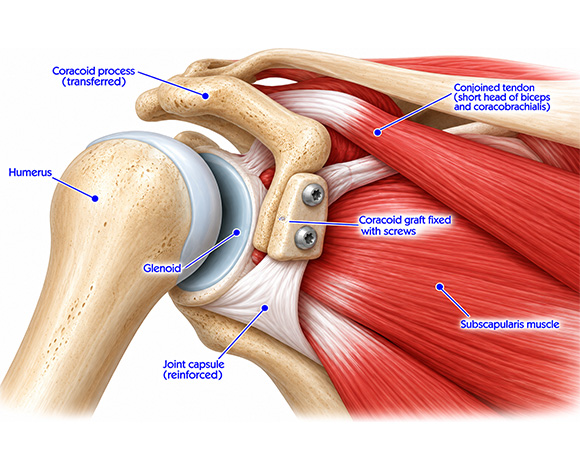
A Latarjet operation involves transferring a small piece of bone from the shoulder blade, called the coracoid process, to the front edge of the glenoid socket. This is also known as a coracoid transfer procedure.
The operation is usually performed under a general anaesthetic. I make an incision at the front of the shoulder and carefully prepare the front of the glenoid, where bone has been lost or where additional support is required. The coracoid bone is detached with its attached tendons and positioned against the front of the socket.
It is then secured with screws to create a firm bony extension or “bumper”. During Latarjet surgery in Edinburgh, the repaired tissues and transferred tendons provide additional dynamic support when the arm is in positions that could otherwise cause the shoulder to dislocate.
The procedure has a “triple effect”:
Bone Block
Widens the front of the socket and restores support where bone has been lost.
Muscle Sling
The attached tendons create a supportive sling around the joint.
Capsule Repair
The joint capsule is repaired to provide further stability.
General Advice Following Surgery
Wear your sling as advised
Following a Latarjet procedure in Edinburgh, your arm will usually be supported in a sling for around three to six weeks. This protects the repair during the early healing period.
Start guided movement early
I will provide instructions on safe early exercises. Physiotherapy normally begins with gentle, guided movement before progressing gradually towards improved range of motion and strength.
Commit to rehabilitation
Rehabilitation is an important part of recovery. At Fife Shoulder Surgery, I will explain what to expect at each stage and work with your physiotherapist to support a safe return to activity.
Plan your return to
work and sport
Your return will depend on your job, symptoms and progress. Desk-based work may be possible earlier than manual work. Contact sport, heavy lifting and gym-based training are usually restricted for approximately four to six months.
Possible Complications
All operations carry potential risks. I will discuss these in detail before Latarjet surgery in Edinburgh, including how they relate to your individual shoulder, medical history and activity goals. Although complications are uncommon, it is important to understand them before deciding whether surgery is right for you.
Infection
Infection can occur around the wound or deeper within the shoulder. This may require antibiotics and, rarely, further treatment.
Nerve or blood
vessel injury
Important nerves and blood vessels are close to the surgical area. Great care is taken to protect them, but injury is a recognised risk.
Bone healing or screw problems
The transferred coracoid bone must unite with the glenoid. Occasionally, the bone may not heal fully or screws may become prominent, loosen or require removal.
Ongoing stiffness, pain or instability
Some patients experience reduced movement, persistent discomfort or, less commonly, further instability after surgery.
Shoulder Surgery Serving Edinburgh and Fife
NHS Consultations
Queen Margaret Hospital
Whitefield Road,
Dunfermline,
KY12 0SU
Victoria Hospital
Hayfield Road,
Kirkcaldy,
KY2 5AH
Private Consultations
Spire Shawfair Park Hospital
10 Easter Shawfair,
Edinburgh,
EH22 1FE
Spire Murrayfield Hospital
122 Corstorphine Road, Edinburgh,
EH12 6UD
Questions about Latarjet surgery in Edinburgh
Why might the Latarjet procedure be recommended for recurrent shoulder dislocations?
Latarjet surgery may be recommended when recurrent anterior shoulder dislocations continue despite rehabilitation or previous surgery. It is particularly useful where the front of the glenoid socket has lost bone, making the shoulder more likely to dislocate again.
What is the difference between the Latarjet procedure and arthroscopic stabilisation?
Arthroscopic stabilisation usually repairs torn soft tissues, such as the labrum, through small incisions. A Latarjet procedure is generally an open operation that transfers bone from the coracoid process to the front of the socket, providing both bone support and a dynamic muscle sling.
Is Latarjet surgery recommended for shoulder bone loss?
Yes. Latarjet surgery is commonly considered when there is significant bone loss from the front of the glenoid, often more than around 15% of the socket width. The transferred coracoid bone helps restore the shape and support of the shoulder socket.
Can the Latarjet procedure help after previous shoulder stabilisation surgery?
Yes. Latarjet surgery may be suitable after a previous shoulder stabilisation procedure has not provided enough stability, especially if scans show glenoid bone loss or there have been further dislocations.
What happens during a Latarjet operation?
During a Latarjet operation, a small section of bone called the coracoid process is moved from the shoulder blade to the front of the glenoid socket. It is secured with screws to create a bone block, while the attached tendons provide additional stability when the arm is in vulnerable positions.
What are the risks and potential complications of Latarjet surgery?
Potential complications include infection, nerve or blood vessel injury, stiffness, ongoing pain, recurrent instability, failure of the transferred bone to heal, and screw prominence or loosening. Your individual risks will be discussed before surgery.
How long does it take to recover from the Latarjet procedure?
Recovery varies, but the early healing phase usually takes several weeks. Physiotherapy starts with guided movement and gradually progresses to strengthening. Heavy lifting, gym training and contact sports are commonly restricted for around four to six months.
Will I need to wear a sling after Latarjet surgery?
Yes. Most patients wear a sling after Latarjet surgery to protect the repair while the bone heals. The sling is typically used for around three to six weeks, depending on your progress and your surgeon's advice.
When can I return to sport after Latarjet surgery?
Return to sport depends on bone healing, shoulder movement, strength and the type of sport you play. Non-contact activities may begin earlier under guidance, while contact sports, heavy gym work and overhead sport are often delayed for approximately four to six months.
Can shoulder dislocations recur after the Latarjet procedure?
The Latarjet procedure is designed to substantially reduce the risk of further shoulder dislocations, but no operation can guarantee that instability will never recur. Following rehabilitation advice, allowing adequate bone healing and returning to sport gradually can help support the best outcome.
Discuss your shoulder instability
If you have experienced repeated dislocations, have been told you have shoulder bone loss, or are considering revision treatment, please get in touch to discuss your options. At Fife Shoulder Surgery, I provide specialist assessment for Latarjet surgery in Edinburgh and other treatments for recurrent shoulder dislocation.
To arrange a consultation, call 01313 162530 or email sunil.sharma2@nhs.scot. I can assess whether surgery for recurrent shoulder dislocation is appropriate and help you make an informed decision about your care.