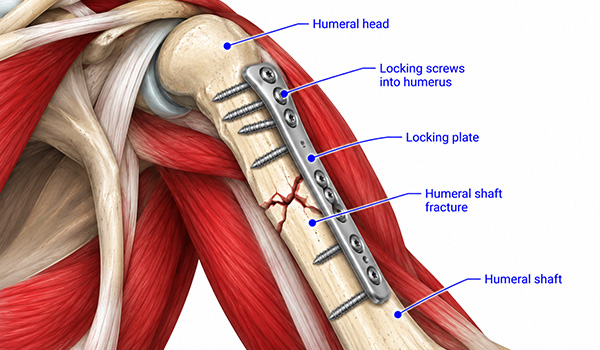
What Is a Humeral Shaft Fracture?
The humerus is the long bone running from the shoulder to the elbow. A break through the middle part of this bone is called a humeral shaft fracture, sometimes referred to as an upper arm fracture or broken humerus.
These injuries can result from a fall, sporting injury, road traffic accident or other significant trauma. Symptoms often include pain, swelling, bruising, deformity and difficulty moving the arm. While many fractures can heal successfully in a brace or splint, Humeral shaft fracture surgery in Edinburgh may be recommended when the bone is displaced, unstable, open, associated with other injuries or unlikely to heal in a satisfactory position without fixation.
What Does the Humeral Shaft Fracture Fixations Surgery Involve?
The purpose of humerus fracture fixation is to restore the alignment of the bone, stabilise the fracture and support healing. I will discuss the most suitable treatment for your individual injury, based on the fracture pattern, your general health and your activity requirements.
Anaesthetic and preparation
The procedure is usually carried out under a general anaesthetic. A nerve block may also be used to provide pain relief after surgery.
Accessing the fracture
I make an incision over the upper arm to access the broken bone. The fracture fragments are carefully repositioned into the correct alignment.
Securing the bone
Most commonly, the fracture is stabilised with a metal plate and screws. In selected cases, a metal nail or rod may be placed inside the centre of the humerus. The method used for Humeral shaft fracture surgery in Edinburgh depends on the location and nature of the fracture.
Closing the wound
Once the bone is stable, the wound is closed and a dressing is applied. Your arm may be placed in a sling for comfort and protection during the early stage of recovery.
General Advice Following Surgery
Recovery after surgery for a broken humerus takes time. Although fixation provides stability, the bone still needs to heal before you can return fully to lifting, exercise and normal daily activities.
Wearing your Sling
You may be given a sling after your operation. This is primarily for comfort and to protect the arm initially. I will advise you on how long it should be worn.
Movement and Physiotherapy
A physiotherapist may provide exercises for your shoulder, elbow, wrist and hand. These are important in preventing stiffness and gradually restoring movement. At Fife Shoulder Surgery, I will ensure you understand the rehabilitation plan appropriate to your injury.
Lifting and Weight-Bearing
Avoid lifting, pushing, pulling or using the operated arm to support your body weight until you have been advised it is safe. Your rehabilitation programme will progress as the fracture heals.
Pain and Swelling
Pain, bruising and swelling are common after an upper arm fracture operation. Take pain medication as prescribed, keep the wound clean and dry, and use ice or elevation only as advised by your clinical team.
Driving and Work
You should not drive until you can control a vehicle safely and perform an emergency manoeuvre comfortably. Returning to work depends on your role; desk-based work may be possible sooner than manual work involving lifting or repetitive arm use.
Possible Complications
All surgery carries some risk, although complications following fracture fixation are uncommon. I will discuss the benefits, risks and alternatives fully before recommending Humeral shaft fracture surgery in Edinburgh. It is important to contact your hospital team promptly if you develop increasing pain, wound redness, discharge, fever, marked swelling, new weakness or numbness.
Infection or Wound problems
There is a small risk of infection around the incision or deeper surgical site, as well as bleeding, swelling or delayed wound healing.
Nerve or Blood
Vessel Injury
The radial nerve runs close to the humeral shaft. Although care is taken to protect nearby structures, nerve irritation or injury can cause numbness, altered sensation or weakness in the arm, wrist or hand.
Stiffness and Ongoing Symptoms
Some patients experience stiffness in the shoulder or elbow, persistent discomfort, reduced strength or a limitation in movement despite successful healing.
Delayed Healing or Fixation Problems
Occasionally, symptoms do not improve as hoped, or another shoulder condition becomes apparent. In a small number of cases, additional treatment or surgery may be considered after subacromial decompression in Edinburgh.
Shoulder Surgery Serving Edinburgh and Fife
NHS Consultations
Queen Margaret Hospital
Whitefield Road,
Dunfermline,
KY12 0SU
Victoria Hospital
Hayfield Road,
Kirkcaldy,
KY2 5AH
Private Consultations
Spire Shawfair Park Hospital
10 Easter Shawfair,
Edinburgh,
EH22 1FE
Spire Murrayfield Hospital
122 Corstorphine Road, Edinburgh,
EH12 6UD
Questions about humeral shaft fracture fixations
When does a humeral shaft fracture require surgery?
Humeral shaft fracture surgery may be recommended if the bone is significantly displaced, unstable, open, associated with other injuries, affecting nerve or blood vessel function, or unlikely to heal in a good position with a brace. Your surgeon will consider the fracture pattern, overall health and activity needs.
Can a broken upper arm heal without surgery?
Yes. Many humeral shaft fractures heal successfully without surgery using a sling, splint or functional brace, followed by monitored movement and rehabilitation. Regular clinical and X-ray review is important to check that the bone remains well aligned and is healing appropriately.
What is humeral shaft fracture fixation surgery?
Humeral shaft fracture fixation is an operation to realign and stabilise a broken humerus. The surgeon holds the fracture in the correct position using metal implants, most commonly a plate and screws, to support healing and allow safe rehabilitation.
How is a humeral shaft fracture diagnosed?
A humeral shaft fracture is usually diagnosed through an examination and X-rays of the upper arm. Further imaging, such as a CT scan, may occasionally be needed to assess a complex fracture or support surgical planning. Nerve function in the arm, wrist and hand is also checked.
What happens during surgery to fix a humeral shaft fracture?
Humerus fracture fixation is usually performed under a general anaesthetic, sometimes with a nerve block for pain relief. An incision is made over the upper arm, the bone fragments are carefully realigned, and fixation is applied. The wound is then closed and dressed, with a sling commonly provided for comfort.
What are the different surgical options for fixing a humeral shaft fracture?
The main options for humeral shaft fracture surgery are plate-and-screw fixation or an intramedullary nail, which is a metal rod placed inside the centre of the humerus. The most suitable method depends on the fracture location, pattern, soft tissues and any associated injuries.
How long does it take to recover from humeral shaft fracture fixation?
Recovery varies according to the fracture and individual healing rate. Early hand, wrist, elbow and shoulder exercises may begin as advised, while the bone commonly takes several months to heal. Strengthening, heavier lifting and return to sport are progressed only after clinical and X-ray confirmation of healing.
How long will I need to wear a sling after humeral shaft fracture surgery?
A sling is often used after surgery for comfort and early protection rather than complete immobilisation. The duration differs between patients and depends on the fixation and fracture stability. Your surgical team will advise when you can reduce sling use and begin guided movement.
When can I return to work, driving and exercise after humeral shaft fracture fixation?
Desk-based work may be possible earlier than manual work, but timing depends on pain, movement and job demands. You should not drive until you can safely control the vehicle and perform an emergency manoeuvre. Exercise and lifting should resume gradually according to your surgeon and physiotherapist’s advice.
What are the risks and potential complications of humeral shaft fracture fixation?
Potential complications include infection, bleeding, wound problems, stiffness, persistent pain, delayed union or non-union, and loosening or failure of plates, screws or nails. The radial nerve lies near the humeral shaft, so temporary or rarely lasting numbness or weakness can occur. Your surgeon will discuss individual risks before treatment.
Discuss Your Treatment Options
If you have sustained a humerus fracture or have been advised that an operation may be required, I can assess your injury and discuss your treatment options clearly. Humeral shaft fracture surgery in Edinburgh is not necessary for every fracture, and I will explain whether non-operative treatment or fixation is most suitable for you.
To arrange a consultation with Fife Shoulder Surgery, please call 01313 162530 or email sunil.sharma2@nhs.scot. I can also discuss related concerns and options for shoulder surgery in Edinburgh where appropriate.