What Is Arthroscopic Subacromial Decompression?
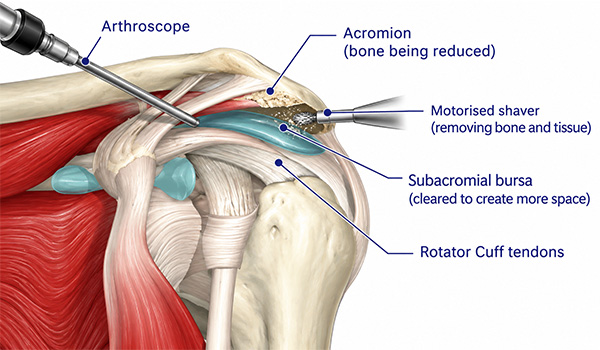
The subacromial area is the space between the top of the upper arm bone, known as the humerus, and the acromion, a bony part of the shoulder blade. The coracoacromial ligament completes the arch above this space.
The rotator cuff tendons and a fluid-filled cushion called the bursa sit within this area. In certain arm positions, these structures can become pinched, inflamed or irritated. This is often referred to as shoulder impingement.
Pain is commonly felt when reaching overhead, lifting, putting on a jacket sleeve or using the arm away from the body. Subacromial decompression in Edinburgh is a form of keyhole shoulder surgery that may be considered when symptoms remain troublesome despite appropriate non-surgical treatment.
Not everyone with shoulder impingement requires an operation. I will assess your symptoms, examine your shoulder and arrange imaging where appropriate before discussing whether surgery is likely to help.
What Does the Arthroscopic Subacromial Decompression Surgery Involve?
Arthroscopic subacromial decompression is usually carried out under a general anaesthetic. It is a type of keyhole surgery, also known as shoulder arthroscopy, performed through two or three small puncture wounds around 5mm in length.
Step 1: Assessing the Shoulder
I insert a small camera through one of the keyhole openings to examine the inside of the shoulder and subacromial space. This allows me to assess the bursa, rotator cuff tendons and surrounding structures.
Step 2: Treating Inflamed Tissue
Fine instruments are inserted through the other openings. Where appropriate, I remove inflamed bursal tissue and release the coracoacromial ligament.
Step 3: Creating More Space
I carefully shave a small amount of bone from the underside of the acromion. This is sometimes called an acromioplasty. Increasing the space beneath the acromion reduces pressure on the bursa and rotator cuff tendons, allowing irritated tissues to settle.
The exact details of subacromial decompression in Edinburgh are tailored to the findings in your shoulder at the time of surgery.
General Advice Following Surgery
Going Home
Most patients are able to go home on the day of their procedure. Occasionally, an overnight stay is needed. Before discharge, a doctor, nurse or physiotherapist will review you, explain your exercises and provide advice for the early stages of recovery.
Wearing a Sling
You will usually be given a sling for comfort. It is not normally required to protect a repair, so you can remove it as much as you wish. I encourage you to discard the sling once your shoulder feels comfortable enough.
Using Your Arm
Early, gentle movement of the arm is encouraged. You will be shown exercises to maintain movement and begin restoring shoulder function. It is important to follow the rehabilitation plan provided, particularly if additional treatment has been undertaken during your shoulder arthroscopy.
Returning to Work
and Activities
Many people return to work within one to four weeks. Desk-based work may be possible sooner, while manual work, heavy lifting and repeated overhead activity often require more recovery time. I can provide individual guidance based on your occupation and progress.
Expected Recovery
Symptoms are often around 80% improved by three months, but recovery is gradual. It can take up to a year for the shoulder to settle fully, particularly if pain and inflammation have been present for some time. Recovery following subacromial decompression in Edinburgh varies between individuals.
Risks and Possible Complications
All operations carry potential risks. Serious complications after shoulder impingement surgery are uncommon, but it is important that you understand the possible limitations and complications before deciding whether to proceed. I will discuss these with you in relation to your individual health, symptoms and planned treatment.
Anaesthetic-Related Complications
General anaesthesia is very safe for most people, but there are recognised risks. Your anaesthetist will discuss these with you before your operation.
Infection
Infection in the small wounds or deeper within the shoulder is uncommon. It may require antibiotics and, rarely, further surgery.
Continued Pain
or Stiffness
Some patients experience prolonged pain, stiffness or slower-than-expected improvement. Physiotherapy, exercises and time are often helpful, although further assessment may be required if symptoms persist.
Need for
Further Surgery
Occasionally, symptoms do not improve as hoped, or another shoulder condition becomes apparent. In a small number of cases, additional treatment or surgery may be considered after subacromial decompression in Edinburgh.
Shoulder Surgery Serving Edinburgh and Fife
NHS Consultations
Queen Margaret Hospital
Whitefield Road,
Dunfermline,
KY12 0SU
Victoria Hospital
Hayfield Road,
Kirkcaldy,
KY2 5AH
Private Consultations
Spire Shawfair Park Hospital
10 Easter Shawfair,
Edinburgh,
EH22 1FE
Spire Murrayfield Hospital
122 Corstorphine Road, Edinburgh,
EH12 6UD
Questions about arthroscopic subacromial decompression
When should I see a shoulder specialist for ongoing shoulder pain?
Consider seeing a shoulder specialist if pain lasts several weeks, affects sleep, work, sport or daily activities, or is associated with weakness, stiffness, instability or reduced movement. A consultant shoulder surgeon can assess the cause and discuss appropriate non-surgical or surgical treatment.
What shoulder problems may require surgery rather than physiotherapy?
Surgery may be considered for conditions such as significant rotator cuff tears, recurrent shoulder dislocations, persistent AC joint pain, severe arthritis, some fractures and symptoms that have not improved with physiotherapy, activity modification, medication or injections. The right option depends on your diagnosis and goals.
How do I know if my shoulder pain is caused by a rotator cuff tear?
A rotator cuff tear can cause pain when lifting the arm, weakness, night pain and difficulty with overhead activity. A clinical assessment, radiographs and, where appropriate, ultrasound or further imaging can help confirm the diagnosis and guide treatment.
What are the treatment options for a frozen shoulder that is not improving?
Frozen shoulder is often managed initially with pain relief, injections, physiotherapy and time. If severe stiffness and restricted movement persist, treatment may include manipulation under anaesthetic or arthroscopic arthrolysis to release the tight shoulder capsule.
How long does it take to recover from shoulder surgery?
Recovery varies according to the procedure, the condition treated and individual healing. Keyhole procedures may allow earlier movement, while rotator cuff repair, stabilisation and shoulder replacement require a structured rehabilitation programme over several months. Your expected recovery plan will be discussed before surgery.
Can shoulder surgery help if physiotherapy and injections have not worked?
In selected cases, surgery can help when suitable non-operative treatment has not relieved symptoms. Arthroscopic procedures, tendon repair, joint replacement or fracture fixation may be considered depending on the cause of pain, imaging findings, function and overall health.
What happens during a consultation with a shoulder surgeon?
Your consultation will include a discussion of your symptoms, injury history, activity levels and treatment goals, followed by a clinical examination. Where appropriate, a one-stop shoulder clinic assessment may include radiographs and ultrasound to help clarify the diagnosis and treatment options.
How can I find a specialist shoulder surgeon for shoulder pain in Fife?
Mr Sunil Sharma provides specialist shoulder and elbow consultations for patients from Fife, Edinburgh and surrounding areas. NHS consultations are available at Queen Margaret Hospital in Dunfermline and Victoria Hospital in Kirkcaldy, with private appointments in Edinburgh.
What is the difference between shoulder replacement and keyhole shoulder surgery?
Keyhole shoulder surgery, or arthroscopy, uses small incisions to treat problems such as rotator cuff tears, instability, calcific deposits or AC joint arthritis. Shoulder replacement replaces damaged joint surfaces and is usually considered for severe arthritis, major joint damage or certain complex fractures.
How soon can I return to work, driving and sport after shoulder surgery?
Return times depend on the operation, which arm is affected, your occupation and recovery progress. Driving is only advised when you can safely control the vehicle and are no longer limited by a sling or pain. Work and sport should be resumed gradually following your surgeon and physiotherapy advice.
Discuss Your Shoulder Symptoms
If you have persistent shoulder pain, painful reaching or difficulty with work, sport or daily activities, I can assess your condition and discuss suitable options. Physiotherapy, activity modification, pain relief and injections may be appropriate before considering surgery.
To arrange a consultation for subacromial decompression in Edinburgh or to discuss shoulder surgery in Edinburgh,
please contact Fife Shoulder Surgery on 01313 162530 or email sunil.sharma2@nhs.scot.