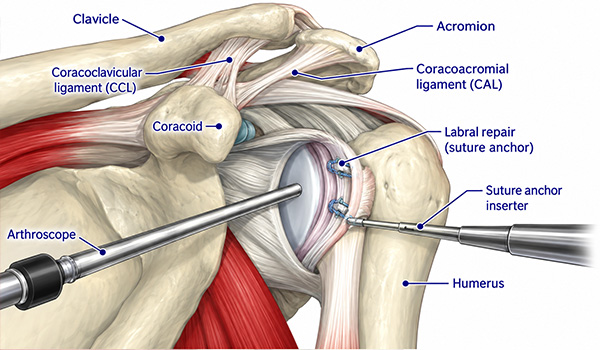
What is Arthroscopic Stabilisation?
The shoulder joint is designed to allow a large amount of movement. This makes support from the surrounding ligaments, labrum and muscles essential. When the shoulder dislocates, these structures can become stretched or torn, increasing the risk of further instability.
Arthroscopic shoulder stabilisation is a keyhole procedure used to repair damaged structures deep within the shoulder joint. It is often considered for patients with recurrent shoulder dislocation, ongoing feelings of instability, or a confirmed labral and ligament injury. I will assess whether shoulder stabilisation surgery in Edinburgh is suitable following a detailed consultation and imaging where required.
What Does Arthroscopic Stabilisation Involve?
The aim of shoulder instability surgery is to restore stability by repairing the overstretched or torn ligaments and labrum around the shoulder joint. In many cases, this can be completed using arthroscopic, or keyhole, techniques.
During the operation, I inspect the shoulder joint using a small camera inserted through small puncture wounds. Specialised instruments are then used to assess the ligaments, labrum and joint surfaces. If a Bankart lesion or similar injury is present, the damaged tissue may be repaired and secured back to the edge of the shoulder socket using small anchors.
For suitable patients, arthroscopic stabilisation in Edinburgh can offer a less invasive approach than open surgery. However, the exact technique depends on the pattern of injury, bone loss, previous dislocations and individual shoulder anatomy. I will explain the recommended procedure, its expected benefits and the alternatives before you decide whether to proceed.
General Advice Following Surgery
Pain Relief
A nerve block is usually used during surgery, so your shoulder and arm may feel numb for several hours. As it wears off, soreness is expected. Pain relief will be provided for use in hospital and at home.
Wearing a Sling and Body Belt
You will return from theatre wearing a sling to protect the repaired tissues. This is usually worn for around six weeks. A body belt may also be needed for the first three weeks to keep the shoulder still.
Wound Care
Arthroscopic stabilisation is usually performed through two or three small puncture wounds, covered with adhesive strips. Keep the dressings dry until the wounds heal, normally within five to seven days. Report redness, discharge or increasing pain.
Driving, Work and
Leisure Activities
Do not drive for at least eight weeks, or while wearing a sling. Returning to work, leisure activities and sport depends on your occupation, recovery and shoulder demands. I and your physiotherapist will provide individual guidance.
Follow-up Appointments and Physiotherapy
A follow-up appointment is normally arranged around three weeks after surgery. Your recovery will be monitored throughout rehabilitation, with formal physiotherapy commonly beginning at approximately six weeks to restore movement, strength and shoulder confidence.
Risks and Possible Complications
Every operation carries some risk, although serious complications are uncommon. Before shoulder stabilisation surgery in Edinburgh, I will discuss the potential risks in relation to your individual health, shoulder problem and proposed procedure. Careful rehabilitation is important in supporting a safe recovery and the best possible functional outcome.
Continued Instability
Although surgery aims to reduce the risk of future dislocation, instability can occasionally recur, especially with further injury or a return to high-risk contact or overhead sports.
Stiffness
Some loss of movement or shoulder stiffness can occur after surgery. Physiotherapy is carefully planned to protect the repair while gradually restoring movement and strength.
Infection or
Wound Problems
Infection, bleeding, swelling, numbness or delayed wound healing are possible after any surgical procedure, but are uncommon.
Nerve or Blood
Vessel Injury
Important nerves and blood vessels lie around the shoulder. Injury is rare but is a recognised risk of shoulder dislocation surgery.
Shoulder Surgery Serving Edinburgh and Fife
NHS Consultations
Queen Margaret Hospital
Whitefield Road,
Dunfermline,
KY12 0SU
Victoria Hospital
Hayfield Road,
Kirkcaldy,
KY2 5AH
Private Consultations
Spire Shawfair Park Hospital
10 Easter Shawfair,
Edinburgh,
EH22 1FE
Spire Murrayfield Hospital
122 Corstorphine Road, Edinburgh,
EH12 6UD
Questions about arthroscopic stabilisation
When is surgery recommended for a shoulder that keeps dislocating?
Shoulder stabilisation surgery may be recommended if you have recurrent dislocations, persistent feelings of instability, a confirmed labral or ligament tear, or difficulty returning to work or sport. The decision depends on your symptoms, activity level, imaging findings, bone loss and shoulder anatomy.
Can a shoulder dislocation cause permanent instability?
A dislocation can stretch or tear the labrum and ligaments that help keep the shoulder joint stable. This can increase the chance of further dislocations or ongoing apprehension with certain movements. Early specialist assessment can identify whether rehabilitation or shoulder stabilisation surgery is appropriate.
What is arthroscopic shoulder stabilisation surgery and what does it treat?
Arthroscopic shoulder stabilisation is a keyhole operation used to treat shoulder instability, recurrent dislocation and injuries such as a Bankart lesion. It aims to repair damaged labrum and ligaments around the shoulder socket to improve joint stability.
What happens during arthroscopic shoulder stabilisation repair?
A small camera is inserted through tiny incisions to inspect the shoulder joint, labrum, ligaments and cartilage surfaces. Special instruments are then used to repair torn tissue, often securing the labrum back to the edge of the socket with small anchors.
Can a torn labrum be repaired during shoulder stabilisation surgery?
Yes. A torn labrum, including a Bankart lesion caused by shoulder dislocation, can often be repaired during arthroscopic stabilisation. The damaged tissue is repositioned and fixed to the socket using anchors, where appropriate for the injury pattern.
What are the alternatives to arthroscopic shoulder stabilisation surgery?
Alternatives may include physiotherapy to strengthen the shoulder muscles, activity modification, pain management and monitoring symptoms. If there is significant bone loss, previous failed surgery or a complex injury pattern, an open stabilisation or bone augmentation procedure may be more suitable than arthroscopy.
How long does it take to recover from shoulder stabilisation surgery?
Recovery varies according to the repair performed, your shoulder condition and rehabilitation progress. A sling is commonly used for around six weeks, with physiotherapy usually beginning at about six weeks. Strengthening and return to demanding activity can take several months.
How long will I need to wear a sling after shoulder stabilisation surgery?
Most patients wear a sling for approximately six weeks after shoulder stabilisation surgery to protect the repair. Some patients may also use a body belt for the first three weeks. Your individual instructions may differ depending on the procedure and your recovery.
When can I return to work, driving and sport after shoulder stabilisation surgery?
You should not drive for at least eight weeks, or until you have been advised it is safe. Return to work depends on whether your role is desk-based or physical. Return to contact, overhead or high-risk sports is gradual and guided by your surgeon and physiotherapist.
What are the risks and potential complications of arthroscopic shoulder stabilisation?
Potential complications include recurrent instability, stiffness, infection, bleeding, swelling, numbness, delayed wound healing and, rarely, nerve or blood vessel injury. Your surgeon will discuss the risks relevant to your health, shoulder injury and proposed operation before treatment.
Arrange a shoulder stabilisation surgery consultation
If you are experiencing repeated dislocations, apprehension when moving your arm, or ongoing pain after a shoulder injury, I can assess your symptoms and discuss whether shoulder stabilisation surgery in Edinburgh may help. Fife Shoulder Surgery provides specialist, patient-focused advice on non-operative care, rehabilitation and surgical options.
To discuss shoulder surgery in Edinburgh or arrange a consultation, please contact me on 01313 162530 or email sunil.sharma2@nhs.scot.