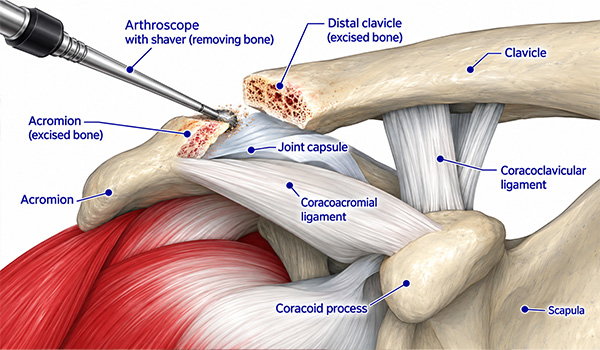
What Is Arthroscopic AC Joint Excision?
The acromioclavicular joint lies at the top of the shoulder, between the acromion (the outer part of the shoulder blade) and the outer end of the clavicle, or collar bone. It can become painful through arthritis, previous injury or repetitive loading.
Typical symptoms include localised pain on top of the shoulder, discomfort when reaching above shoulder height, and pain when bringing the arm across the body. Arthroscopic AC joint excision, also called distal clavicle excision or a Mumford procedure, is a keyhole operation designed to relieve this pain. At Fife Shoulder Surgery, I will assess whether this form of AC joint surgery in Edinburgh is appropriate for your individual symptoms and diagnosis.
What Does the Arthroscopic AC Joint Excision Surgery Involve?
Arthroscopic AC joint excision is performed under a general anaesthetic and usually takes place as a day-case procedure, although an overnight stay is occasionally required.
1. Keyhole access
I perform the operation through two or three small puncture wounds, typically around 5mm in length. A small camera is introduced into the shoulder, allowing me to examine the joint and surrounding structures.
2. Assessment of the shoulder
Shoulder arthroscopy allows me to assess the AC joint and look for any associated shoulder problems which may be contributing to your symptoms.
3. Distal clavicle excision
Using specialist arthroscopic instruments, I carefully remove a small section of bone from the outer end of the clavicle. In some cases, a small amount of adjacent acromion bone is also shaped where necessary.
4. Creating space in the joint
The aim is to create an approximately 8mm gap at the AC joint. This reduces painful bone-on-bone contact while maintaining the supporting ligaments around the joint. AC joint surgery in Edinburgh is tailored to the findings in your shoulder and your treatment needs.
General Advice Following Surgery
Going Home
You will usually go home on the day of surgery or after one night in hospital. Before discharge, a doctor or physiotherapist will review you and provide advice about pain relief, wound care and early exercises.
Wearing a Sling
You will be given a sling for comfort. It is not normally required for prolonged immobilisation and may be removed as often as you wish. I encourage you to begin using the arm gently as comfort allows and to discard the sling as soon as you can do so comfortably.
Exercises and Rehabilitation
You will be given exercises to help restore movement and reduce stiffness. Following the advice provided is an important part of your recovery. Further rehabilitation may be arranged where appropriate.
Work and Daily Activities
Many patients return to work within one to four weeks, depending on the demands of their role. A desk-based role may allow an earlier return than heavy manual work, overhead work or physically demanding employment.
Expected Recovery
Symptoms are often around 80% improved by three months. However, full recovery can take up to a year, particularly where symptoms have been longstanding or other shoulder conditions are present. This is an important consideration when planning shoulder surgery in Edinburgh.
Risks and Possible Complications
All operations carry some risk. Complications after arthroscopic distal clavicle excision are uncommon, but I will discuss the relevant risks with you before surgery so that you can make an informed decision. Your individual risks can vary according to your health, the condition of your shoulder and any previous operations.
Anaesthetic Complications
General anaesthesia is generally very safe, but it carries risks which the anaesthetist will discuss with you before your procedure.
Infection
Infection in the wounds or deeper around the shoulder is rare, but may require antibiotics or, occasionally, further treatment.
Persistent Pain or Stiffness
Some patients experience prolonged pain, reduced movement or stiffness following surgery. Recovery can take time, and rehabilitation is important.
Further Surgery
On rare occasions, symptoms may persist or another shoulder problem may become apparent, meaning further treatment or revision surgery may be considered.
Shoulder Surgery Serving Edinburgh and Fife
NHS Consultations
Queen Margaret Hospital
Whitefield Road,
Dunfermline,
KY12 0SU
Victoria Hospital
Hayfield Road,
Kirkcaldy,
KY2 5AH
Private Consultations
Spire Shawfair Park Hospital
10 Easter Shawfair,
Edinburgh,
EH22 1FE
Spire Murrayfield Hospital
122 Corstorphine Road, Edinburgh,
EH12 6UD
Questions about arthroscopic AC joint excision
When is surgery recommended for AC joint pain that is not improving?
AC joint surgery may be considered when pain from AC joint arthritis, injury or wear-related change continues despite non-operative treatment. This may include activity modification, physiotherapy, pain relief medication or an injection. A specialist assessment helps confirm whether arthroscopic AC joint excision is appropriate.
Can arthroscopic AC joint excision treat arthritis in the shoulder?
Yes. Arthroscopic AC joint excision is commonly used to treat painful arthritis affecting the acromioclavicular joint at the top of the shoulder. The procedure removes a small section of bone from the outer end of the collar bone to reduce painful bone-on-bone contact.
What is an AC joint excision and what does the procedure involve?
An AC joint excision, also called distal clavicle excision or a Mumford procedure, is keyhole shoulder surgery. Through two or three small incisions, a camera and specialist instruments are used to assess the shoulder and remove a small portion of the outer clavicle, creating space at the AC joint.
How is AC joint arthritis diagnosed before surgery?
Diagnosis usually involves discussing your symptoms, examining the shoulder and assessing movements that trigger pain, such as reaching overhead or across the body. Radiographs and, where appropriate, ultrasound may be used during a one-stop assessment to identify AC joint arthritis and other shoulder problems.
What are the alternatives to arthroscopic AC joint excision?
Non-surgical treatment may include modifying painful activities, physiotherapy, anti-inflammatory or other pain-relieving medication, and an AC joint injection where suitable. Surgery is normally considered only if symptoms remain troublesome and significantly affect work, sport, sleep or daily activities.
How long does it take to recover from AC joint excision surgery?
Many patients experience substantial improvement within three months, with symptoms often around 80% improved by this stage. Full recovery after arthroscopic AC joint excision can take up to a year, particularly if symptoms have been present for a long time or there are other shoulder conditions.
How painful is arthroscopic AC joint excision surgery?
It is normal to have pain and soreness after AC joint surgery, particularly during the early recovery period. Pain relief advice will be provided before you leave hospital, and gentle movement and prescribed exercises can help reduce stiffness. Individual pain levels and recovery vary.
When can I return to work, driving and exercise after AC joint excision?
Many people return to desk-based work within one to four weeks, while heavy manual or overhead work may take longer. You should only drive when you are no longer using a sling, can safely control the vehicle and perform an emergency stop comfortably. Exercise should be resumed gradually following your surgeon’s and physiotherapist’s advice.
Can I return to the gym and weightlifting after AC joint excision surgery?
Yes, many patients can return to gym activity and weightlifting after recovery, but this should be gradual. Early rehabilitation focuses on restoring comfortable movement before progressing to strengthening. Heavy lifting, pressing movements and overhead exercise should only be restarted when advised by your surgeon or physiotherapist.
What are the risks and potential complications of AC joint excision surgery?
Complications following arthroscopic distal clavicle excision are uncommon but can include anaesthetic risks, infection, persistent pain, stiffness or reduced movement. In rare cases, symptoms may continue or another shoulder problem may require further treatment or revision surgery. Your individual risks will be discussed before surgery.
Discuss Your AC Joint Pain
If pain at the top of your shoulder is affecting work, sleep, sport or daily activities, I can assess your symptoms and discuss suitable treatment options. Not every patient needs an operation; treatment may include activity modification, physiotherapy, medication or an injection before surgery is considered.
To discuss AC joint surgery in Edinburgh or other options for persistent shoulder pain, please contact Fife Shoulder Surgery on 01313 162530 or email sunil.sharma2@nhs.scot. I can explain what assessment and treatment may involve, including whether shoulder surgery in Edinburgh is appropriate for you.