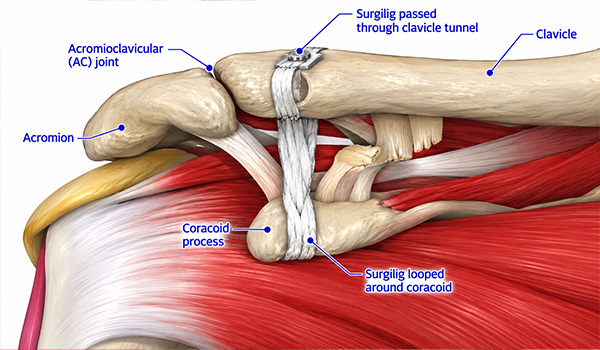
What is AC Joint Reconstruction Using Nottingham Surgilig?
The acromioclavicular (AC) joint sits at the top of the shoulder, where the collarbone meets the acromion, the upper part of the shoulder blade. Strong ligaments normally hold this joint in position.
A fall directly onto the shoulder, sporting injury or other shoulder trauma can damage these ligaments, causing an AC joint injury or “separated shoulder”. This may lead to pain, weakness, movement problems and a noticeable bump over the top of the shoulder.
AC joint reconstruction in Edinburgh is a procedure used to support the collarbone, restore joint stability and improve shoulder function. At Fife Shoulder Surgery, I will assess whether surgery is appropriate for your individual injury, symptoms and activity goals.
What Does the AC Joint Reconstruction Surgery Involve?
AC joint surgery is usually carried out under a general anaesthetic. A regional nerve block may also be used to help with pain relief after the procedure.
Assessment and planning
Before surgery, I review your symptoms, examination findings and imaging to understand the severity and pattern of your AC joint injury.
Stabilising the joint
During the operation, I reposition and stabilise the collarbone using an appropriate reconstruction technique. This may include a Nottingham Surgilig synthetic ligament or another fixation method, depending on the nature of the injury.
Supporting ligament healing
The reconstruction is designed to hold the collarbone in the correct position while the damaged supporting tissues heal.
Wound closure and sling
Once the procedure is complete, the wound is closed and your arm is placed in a sling to protect the reconstruction. AC joint reconstruction in Edinburgh is focused on improving pain, stability and function, rather than solely changing the appearance of the shoulder
General Advice Following Surgery
Your individual recovery plan will be discussed with you in detail. Instructions from me and your physiotherapist should always take priority, as rehabilitation programmes can vary.
Wearing your Sling
You will usually need a sling after surgery to protect the repair. The duration depends on the reconstruction technique and your recovery progress.
Early Movement
A physiotherapist will guide you through safe exercises to begin restoring movement without placing undue stress on the reconstruction.
Avoiding Strain
In the early stages, avoid lifting, pushing, pulling and forceful overhead movements with the operated arm. These activities can put strain on healing tissues.
Managing Pain and Swelling
Pain, bruising, swelling and stiffness are common initially. Take pain relief as advised, and use ice only in accordance with the guidance you are given.
Returning to Work,
Driving and Sport
Desk-based work may be possible after several weeks, while heavy manual work and overhead activity often require longer. You should not drive until you can safely control the vehicle and are no longer restricted by your sling or medication. Contact sports and activities with a risk of falling onto the shoulder may take several months to resume.
Risks and Possible Complications
All operations carry some risk. Complications following shoulder ligament reconstruction are uncommon, but it is important to understand them before deciding on treatment. I will discuss the potential benefits, limitations and risks of AC joint reconstruction in Edinburgh as they apply to you.
Anaesthetic-related Complications
There are risks associated with general anaesthesia and, where used, a regional nerve block.
Infection and
Wound Problems
Infection, delayed wound healing, redness, discharge or bleeding can occur and may require treatment.
Stiffness or
Ongoing Pain
Some patients experience stiffness, reduced movement or continuing discomfort despite surgery and rehabilitation.
Nerve or Blood Vessel Injury
Some patients experience stiffness, reduced movement or continuing discomfort despite surgery and rehabilitation.
Loss of Fixation or
Recurrent Instability
The reconstruction may stretch, fail or lose its position, resulting in persistent prominence, pain or instability. Further treatment may occasionally be required.
Persistent Change in Appearance
A bump or prominence over the AC joint can remain, even after technically successful surgery. The priority is usually improved comfort and function.
Shoulder Surgery Serving Edinburgh and Fife
NHS Consultations
Queen Margaret Hospital
Whitefield Road,
Dunfermline,
KY12 0SU
Victoria Hospital
Hayfield Road,
Kirkcaldy,
KY2 5AH
Private Consultations
Spire Shawfair Park Hospital
10 Easter Shawfair,
Edinburgh,
EH22 1FE
Spire Murrayfield Hospital
122 Corstorphine Road, Edinburgh,
EH12 6UD
Questions about AC joint reconstruction
When is surgery recommended for an AC joint separation?
AC joint reconstruction may be recommended when a separated shoulder causes ongoing pain, weakness, instability or difficulty with work, sport and daily activities despite appropriate non-surgical treatment. Surgery may also be considered for more severe injuries or persistent symptoms from a chronic AC joint separation.
Can a separated AC joint heal without surgery?
Yes. Many AC joint injuries improve with non-surgical treatment such as a sling, pain relief, activity modification and physiotherapy. However, some people continue to experience pain, instability or weakness, particularly after a severe separation, and may benefit from assessment for AC joint reconstruction surgery.
What is AC joint reconstruction using Nottingham Surgilig?
Nottingham Surgilig is a synthetic ligament used in some AC joint reconstruction procedures. It is designed to support the collarbone and help restore stability at the acromioclavicular joint while the injured ligaments and surrounding tissues heal.
How does Nottingham Surgilig reconstruction stabilise the AC joint?
The reconstruction holds the collarbone in a more stable position relative to the shoulder blade. This reduces abnormal movement at the AC joint and supports healing of the damaged ligaments. The exact technique and fixation method are selected according to the injury pattern, timing and individual requirements.
What happens during AC joint reconstruction surgery?
AC joint reconstruction is usually performed under a general anaesthetic, sometimes with a regional nerve block for pain relief. The surgeon repositions and stabilises the collarbone using a reconstruction technique such as Nottingham Surgilig or other fixation. The wound is closed and the arm is placed in a sling to protect the repair.
How is an AC joint separation diagnosed before surgery?
Diagnosis involves discussing the injury and symptoms, examining the shoulder and assessing stability, movement and strength. X-rays are commonly used to assess the joint position, while further imaging may occasionally be needed to clarify associated injuries or guide surgical planning.
How long does it take to recover from AC joint reconstruction?
Recovery varies depending on the reconstruction method, severity of injury and rehabilitation progress. A sling is usually required initially, followed by guided physiotherapy to restore movement and strength. Functional recovery takes several months, and higher-demand activities may take longer.
When can I return to work, driving and sport after AC joint reconstruction?
Desk-based work may be possible after several weeks, depending on pain and sling use. Heavy manual work, lifting and overhead activity usually require a longer recovery period. You should only drive when you are out of the sling, are not affected by pain medication and can safely control the vehicle.
Can I return to contact sports after AC joint reconstruction surgery?
Many patients can return to contact sports after AC joint reconstruction, but only when strength, movement and shoulder control have recovered sufficiently. Activities with a risk of falling onto the shoulder generally need to be avoided for several months. Your surgeon and physiotherapist will advise when it is safe to return.
What are the risks and potential complications of AC joint reconstruction?
Potential complications include anaesthetic risks, infection, wound problems, stiffness, ongoing pain, nerve or blood vessel injury, and loss of fixation or recurrent instability. A visible bump over the AC joint may remain despite surgery. These risks and the expected benefits will be discussed during your consultation.
Discuss Your AC Joint Injury
If you have ongoing pain, weakness, instability or a visible deformity following a shoulder injury, I can assess whether treatment such as physiotherapy, injections or AC joint reconstruction in Edinburgh may be suitable. As an experienced AC joint reconstruction surgeon in Edinburgh, I will explain your diagnosis, the available options and realistic recovery expectations.
To arrange a consultation with Fife Shoulder Surgery, call 01313 162530 or email sunil.sharma2@nhs.scot. I can help you understand whether surgery for a separated shoulder in Edinburgh is appropriate for your circumstances.