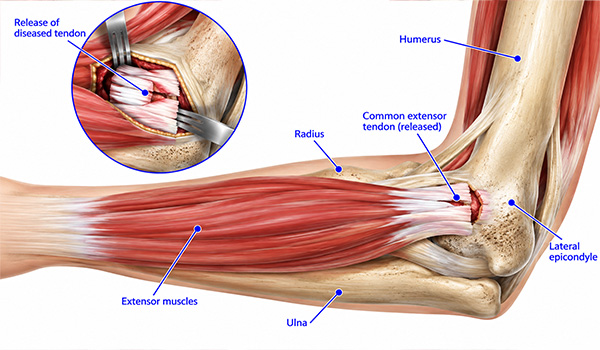
What is Tennis / Golfer's Elbow Release?
Tennis elbow, also known as lateral epicondylitis, affects the tendons on the outside of the elbow. Golfer's elbow, or medial epicondylitis, affects tendons on the inside of the elbow. Both may cause elbow pain during gripping, lifting or repetitive wrist and forearm movements.
Most people improve without an operation through activity modification, physiotherapy and other treatments. Tennis elbow surgery in Edinburgh may be considered where symptoms remain significant despite appropriate non-surgical care. An elbow release aims to remove unhealthy tendon tissue, promote healing and improve arm function.
What Does a Tennis / Golfer's Elbow Release Surgery Involve?
Tennis elbow surgery in Edinburgh is usually performed under a general anaesthetic. A nerve block may also be used to provide additional pain relief after the procedure.
1. Preparing the area
I make a small incision over the affected part of the elbow, either on the outer side for tennis elbow or the inner side for golfer's elbow.
2. Assessing the tendon
The affected tendon is carefully identified and examined to determine the extent of damaged or unhealthy tissue.
3. Treating the tendon
Damaged tissue is removed and part of the tendon may be released from its attachment to the bone where appropriate. This tendon release is intended to stimulate healing.
4. Repair and closure
The tendon is repaired or reattached if necessary. The wound is closed and covered with a dressing. Your arm may be supported in a sling for comfort.
The precise tennis elbow operation in Edinburgh will depend on your diagnosis, symptoms and tendon condition.
General Advice Following Surgery
Sling and comfort
You may be given a sling after your operation. This is usually for comfort and support rather than long-term immobilisation. Please use it according to the advice given to you.
Pain and swelling
It is normal to have some pain, bruising and swelling around the elbow and forearm. Take pain relief as prescribed, and use ice only as advised by your clinical team.
Wound care
Keep your dressing and wound clean and dry in line with the instructions you receive before leaving hospital. Contact your care team if you notice increasing redness, discharge or swelling.
Movement and physiotherapy
Early exercises for the elbow, wrist and hand may be provided by your physiotherapist. These help restore movement safely while protecting the healing tendon.
Work, driving and sport
Avoid heavy lifting, forceful gripping and repetitive activities initially. You should not drive until you can safely control the vehicle and perform an emergency manoeuvre. Returning to work, golf, racquet sports or manual activity should be guided by your recovery and physiotherapy programme.
Risks and Possible Complications
As with any operation, there are risks associated with tennis elbow surgery in Edinburgh. Complications are uncommon, but it is important that you understand them before choosing surgery. I will discuss your individual risks, expected recovery and alternatives during your consultation at Fife Shoulder Surgery.
Anaesthetic-related problems
There are small risks associated with general anaesthesia and, where used, a nerve block.
Infection, bleeding or swelling
Infection around the wound, bleeding or significant swelling can occur after surgery and may require further treatment.
Nerve or blood
vessel injury
Nerves and blood vessels are close to the elbow. Injury is uncommon but can cause numbness, altered sensation or weakness.
Incomplete improvement or recurrence
Surgery cannot guarantee complete resolution of symptoms. Tendon healing takes time, and further treatment may occasionally be needed if symptoms persist or recur.
Elbow Surgery Serving Edinburgh and Fife
NHS Consultations
Queen Margaret Hospital
Whitefield Road,
Dunfermline,
KY12 0SU
Victoria Hospital
Hayfield Road,
Kirkcaldy,
KY2 5AH
Private Consultations
Spire Shawfair Park Hospital
10 Easter Shawfair,
Edinburgh,
EH22 1FE
Spire Murrayfield Hospital
122 Corstorphine Road, Edinburgh,
EH12 6UD
Questions about tennis / golfers elbow release
When is elbow replacement surgery recommended for severe elbow pain?
Elbow replacement surgery may be recommended when severe pain, stiffness or loss of function from arthritis or joint damage significantly affects sleep, independence and everyday activities, and non-operative treatments are no longer providing sufficient relief.
What elbow conditions can be treated with an elbow replacement?
Elbow arthroplasty may be considered for severe osteoarthritis, rheumatoid or inflammatory arthritis, post-traumatic arthritis, major joint damage and selected complex elbow fractures. Suitability depends on the condition of the joint, ligaments, bone quality and your activity needs.
How do I know if I need an elbow replacement?
A consultant elbow surgeon will assess your symptoms, elbow movement, strength, X-rays or scans, medical health and how the condition affects your daily life. Elbow replacement in Edinburgh is usually considered only after appropriate non-surgical options have been discussed.
What is involved in elbow replacement surgery?
Elbow replacement, also called elbow arthroplasty, is usually carried out under general anaesthetic, often with a nerve block. Damaged joint surfaces are removed and replaced with metal and medical-grade plastic components designed to provide stable, controlled elbow movement.
What are the alternatives to elbow replacement surgery?
Alternatives depend on the underlying problem and may include pain relief, activity modification, physiotherapy, injections, splinting or other elbow surgery. In some cases, joint-preserving procedures or fracture reconstruction may be more appropriate than total elbow replacement.
How long does it take to recover from an elbow replacement?
Recovery varies between patients. Early controlled movement and physiotherapy are important because the elbow can stiffen quickly. Comfort and movement often improve over the first few months, while strength, confidence and functional recovery may continue to develop thereafter.
How long will I need to wear a sling after elbow replacement surgery?
A sling is normally provided for support and comfort after elbow replacement surgery. The length of time it is needed depends on the operation, implant stability and your rehabilitation plan. Your surgeon and physiotherapist will advise when to reduce its use.
When can I return to work, driving and normal activities after elbow replacement?
You should not drive until you can safely control the vehicle and perform an emergency manoeuvre. Desk-based work may be possible sooner than manual work. Heavy lifting, pushing, pulling and weight-bearing through the arm are restricted initially and often limited long term.
How successful is elbow replacement surgery for relieving pain and improving movement?
Elbow replacement is generally intended to reduce pain and improve useful movement for everyday tasks. It cannot restore the elbow to normal strength or guarantee full movement, particularly if the joint was very stiff before surgery. Outcomes vary with the underlying condition and rehabilitation.
How long does an elbow replacement typically last?
The lifespan of an elbow replacement varies depending on implant type, bone and ligament condition, activity levels and long-term loading. Avoiding heavy repetitive lifting helps reduce the risk of loosening, wear and failure. Ongoing follow-up may be advised to monitor the replacement.
Discuss Your Elbow Symptoms
If elbow pain is affecting your work, sleep, sport or daily activities, I can assess your symptoms and discuss suitable treatment options. Tennis elbow surgery in Edinburgh is generally reserved for people whose symptoms have not improved with appropriate non-operative care.
To arrange a consultation with Fife Shoulder Surgery, please call 01313 162530 or email sunil.sharma2@nhs.scot. I can advise whether tennis elbow or golfer's elbow surgery in Edinburgh may be suitable for you and outline the next steps in your care.