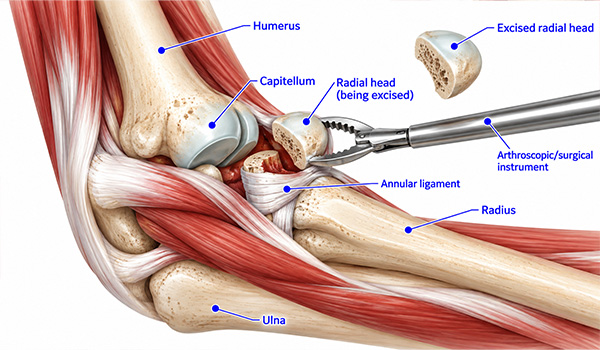
What Is Radial Head Excision?
The radial head is the upper part of the radius, one of the two bones in the forearm. It forms part of the elbow joint and helps you bend and straighten the elbow, as well as rotate your forearm to turn the palm upwards or downwards.
A radial head fracture commonly occurs after a fall onto an outstretched hand, although it may also result from a direct blow or more significant elbow injury. Many fractures can be treated without an operation. However, surgery may be considered if the radial head is severely fragmented, cannot be repaired satisfactorily, or is contributing to persistent pain, stiffness or mechanical catching.
Radial head excision in Edinburgh involves removing the damaged radial head where this is the most appropriate treatment option. As a specialist providing elbow surgery in Edinburgh, I assess not only the fracture itself but also the ligaments, surrounding bones and stability of the elbow and forearm before making a recommendation.
What Does a Radial Head Excision Involve?
Every operation is planned around the individual injury. Before recommending Radial head excision in Edinburgh, I will explain why removal rather than repair or replacement may be appropriate in your circumstances.
Anaesthetic and pain relief
The procedure is usually carried out under a general anaesthetic. A nerve block may also be used to help manage pain in the hours after surgery.
Accessing the elbow
I make a carefully positioned incision over the outside of the elbow to access the radial head while protecting the surrounding muscles, ligaments, nerves and blood vessels.
Removing the damaged radial head
The damaged or fragmented section of bone is identified and removed. The precise technique depends on the pattern of the fracture and whether there are associated elbow injuries.
Checking movement and stability
Once the radial head has been removed, I assess the movement and stability of the elbow and forearm. This is particularly important because the radial head can contribute to elbow stability.
Closing the wound
The wound is closed and covered with a dressing. Your arm may be supported in a sling for comfort following surgery.
In some cases, radial head removal is not the best option, particularly if there is ligament damage or instability elsewhere in the elbow. I will discuss all suitable treatment options with you before proceeding.
General Advice Following Surgery
Recovery after Radial head excision in Edinburgh is gradual. My team at Fife Shoulder Surgery will provide guidance specific to your operation, injury and rehabilitation plan.
Sling use
You may be given a sling for support and comfort. It should be used as advised, but prolonged immobilisation is usually avoided where possible because the elbow can become stiff.
Pain and swelling
Pain, bruising and swelling are common during the early stages. Take prescribed medication as directed. Keeping the arm elevated and using ice, where advised, may help control discomfort and swelling.
Wound care
Keep the dressing and wound clean and dry in accordance with the instructions given when you leave hospital. Please contact your care team if you have concerns about the wound.
Movement and physiotherapy
Early, controlled movement is often important. A physiotherapist may give you exercises for the elbow, wrist and hand, including work to restore bending, straightening and forearm rotation.
Returning to normal activities
Avoid heavy lifting, pushing, pulling and activities that place significant stress through the operated arm until you have been advised that it is safe. Office-based work may be possible sooner than manual work. You should not drive until you can safely control the vehicle and perform an emergency manoeuvre.
Risks and Possible Complications
All operations carry some risk, although complications are uncommon. The purpose of Radial head excision in Edinburgh is to improve pain and function, but it cannot guarantee that the elbow will return fully to its pre-injury level of movement or strength. I will discuss the potential benefits, limitations and risks in detail during your consultation.
Anaesthetic, bleeding and infection
There are small risks related to anaesthesia, bleeding, swelling and infection around the wound or surgical site.
Nerve or blood vessel injury
Nerves and blood vessels run close to the elbow. Injury is unusual but may cause numbness, altered sensation, weakness or circulation problems.
Stiffness and ongoing symptoms
Elbow stiffness, reduced rotation of the forearm, scar sensitivity, persistent pain or weakness can occur after injury and surgery.
Instability or altered mechanics
Removing the radial head can affect the mechanics and stability of the elbow and forearm, especially where there are associated ligament or bone injuries. This is why careful assessment is essential before surgery.
If you develop worsening pain, increasing redness, wound discharge, a high temperature, marked swelling, new weakness or numbness in the hand or arm, seek medical advice promptly.
Elbow Surgeon Serving Edinburgh and Fife
NHS Consultations
Queen Margaret Hospital
Whitefield Road,
Dunfermline,
KY12 0SU
Victoria Hospital
Hayfield Road,
Kirkcaldy,
KY2 5AH
Private Consultations
Spire Shawfair Park Hospital
10 Easter Shawfair,
Edinburgh,
EH22 1FE
Spire Murrayfield Hospital
122 Corstorphine Road, Edinburgh,
EH12 6UD
Questions about radial head excision
When is radial head excision recommended for an elbow injury?
Radial head excision may be recommended when the radial head is badly fragmented, cannot be repaired reliably and is causing pain, stiffness or mechanical catching. It is only suitable where the elbow and forearm remain sufficiently stable without the radial head.
What is a radial head fracture and when does it require surgery?
A radial head fracture affects the upper part of the radius at the outside of the elbow, often after a fall onto an outstretched hand. Simple fractures may heal without surgery, but an operation may be considered for displaced, fragmented or unstable fractures, or where movement is blocked.
What does radial head excision surgery involve?
Radial head excision is usually performed under general anaesthetic, sometimes with a nerve block for pain relief. An incision is made on the outside of the elbow, the damaged radial head is removed, and the surgeon checks elbow and forearm movement and stability before closing the wound.
Can radial head excision relieve persistent pain after a radial head fracture?
It can help relieve pain, catching and restricted movement caused by an unrepairable fractured radial head. However, outcomes depend on the original injury, the condition of the ligaments and cartilage, and whether there are associated fractures or elbow instability.
What are the alternatives to radial head excision surgery?
Alternatives may include non-operative treatment, fracture fixation with screws or plates, radial head replacement, physiotherapy or pain management. The most appropriate option depends on the fracture pattern, bone quality, symptoms and stability of the elbow and forearm.
How long does it take to recover from radial head excision?
Recovery varies according to the severity of the injury and any associated ligament or bone damage. Early healing takes several weeks, while regaining movement, strength and confidence for heavier activities can take several months. Your rehabilitation plan will be tailored to your operation.
How soon can I move my elbow after radial head excision surgery?
Early, controlled elbow movement is often encouraged to reduce stiffness, although the exact timing depends on the stability of your elbow and any additional repairs performed. A sling may be used for comfort, and physiotherapy exercises may include elbow, wrist and forearm rotation movements.
When can I return to work, driving and exercise after radial head excision?
Office-based work may be possible earlier than manual work. You should avoid heavy lifting, pushing, pulling and impact exercise until advised otherwise. Do not drive until you can safely control the vehicle, are no longer limited by pain or medication, and can perform an emergency manoeuvre.
Will radial head excision affect the movement or strength of my elbow?
Some patients may have ongoing stiffness, reduced forearm rotation or weakness following a significant elbow injury. The aim of surgery and rehabilitation is to improve pain and function, but full pre-injury movement and strength cannot always be guaranteed.
What are the risks and potential complications of radial head excision?
Potential risks include infection, bleeding, wound problems, nerve or blood vessel injury, stiffness, persistent pain, reduced strength, altered elbow mechanics and instability. Further treatment may occasionally be needed, particularly after complex injuries or if post-traumatic arthritis develops.
Discuss Your Elbow Symptoms
If you have sustained an elbow fracture or continue to experience pain, stiffness, catching or difficulty rotating your forearm, I can assess your symptoms and explain the available treatment options. To discuss Radial head excision in Edinburgh, or to arrange a consultation with Fife Shoulder Surgery, please contact my team on 01313 162530 or email sunil.sharma2@nhs.scot.