What Is Distal Biceps Tendon Repair?
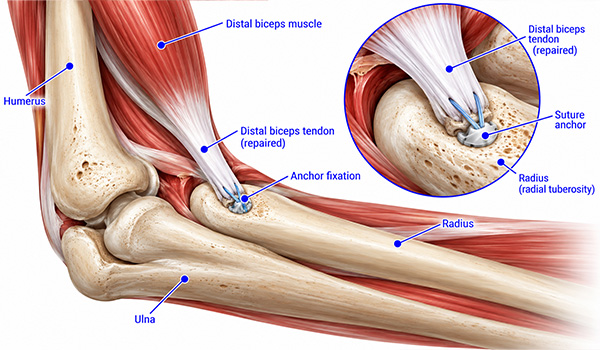
The distal biceps tendon connects the biceps muscle at the front of the upper arm to the radius bone in the forearm, close to the elbow. A tendon rupture may occur during a sudden lifting injury, forceful pull or sporting activity. It can cause pain, swelling, bruising and a noticeable loss of strength when turning the palm upwards or bending the elbow.
Distal biceps tendon repair in Edinburgh is an operation to reattach the torn tendon to the radius bone. Although this page is described as arthroscopic repair, distal biceps repair is usually performed through a small incision at the front of the elbow rather than by arthroscopy alone. The most suitable approach will depend on the injury and your individual circumstances.
Not every torn biceps tendon requires surgery. I will discuss non-operative and surgical options with you, taking account of your symptoms, activity level, occupation and functional goals.
What Does an Arthroscopic Distal Biceps Tendon Repair Surgery Involve?
For patients undergoing distal biceps tendon repair in Edinburgh, the procedure is usually carried out under a general anaesthetic, often with a regional nerve block to assist with pain relief afterwards.
I make a carefully positioned incision at the front of the elbow to identify the torn tendon and prepare the area where it normally attaches to the radius bone. The tendon is then brought back to its correct position and secured using strong sutures and specialised fixation devices, such as a button, anchor or screw.
The precise technique depends on the pattern of the tendon rupture, the time since injury and the quality of the tendon tissue. Once the repair is secure, the wound is closed and the arm is placed in a sling or protective brace.
Early, controlled rehabilitation is important after elbow surgery in Edinburgh. However, the repair must also be protected while the tendon heals back to the bone.
General Advice Following Surgery
Sling or brace
You may be given a sling or hinged elbow brace after distal biceps tendon repair in Edinburgh. Please use it exactly as instructed, as it protects the repair during the early stages of healing.
Pain and swelling
It is normal to experience discomfort, swelling and bruising around the elbow and forearm. Take pain relief as prescribed, keep the arm elevated where possible and use ice only as advised by your clinical team.
Physiotherapy and exercises
I will provide guidance on when to begin gentle exercises. Your physiotherapist will help you gradually restore elbow movement, forearm rotation and strength without placing undue strain on the repair.
Activity and work
Avoid lifting, pulling, pushing or carrying with the operated arm until you are advised that it is safe. Returning to office-based work may be possible earlier than returning to manual, repetitive or heavy work.
Driving and sport
Do not drive until you can safely control the vehicle, perform an emergency manoeuvre and are no longer restricted by a sling, brace or pain medication. Return to gym activity, sport and heavy lifting must be gradual and guided by your recovery.
Risks and Possible Complications
All operations carry potential risks. Complications following distal biceps tendon repair in Edinburgh are uncommon, but it is important that you understand them before deciding on treatment. I will discuss the risks relevant to your injury and explain how these are managed.
Infection or wound problems
There may be infection, delayed wound healing, bleeding, swelling or an adverse reaction to dressings or medication.
Nerve irritation
Nerves around the elbow and forearm can be stretched or irritated during surgery. This may lead to numbness, altered sensation or weakness, which is often temporary but can occasionally persist.
Stiffness and reduced movement
The elbow may become stiff after injury or surgery. Following your rehabilitation programme is important in helping to restore movement safely.
Failure of healing or re-rupture
In some cases, the tendon may not heal fully or may tear again, particularly if the arm is overloaded too early. Further treatment or surgery may occasionally be required.
Contact your medical team promptly if you develop increasing pain, marked swelling, redness, wound discharge, fever,
new numbness or weakness in the hand or arm.
Elbow Surgeon Serving Edinburgh and Fife
NHS Consultations
Queen Margaret Hospital
Whitefield Road,
Dunfermline,
KY12 0SU
Victoria Hospital
Hayfield Road,
Kirkcaldy,
KY2 5AH
Private Consultations
Spire Shawfair Park Hospital
10 Easter Shawfair,
Edinburgh,
EH22 1FE
Spire Murrayfield Hospital
122 Corstorphine Road, Edinburgh,
EH12 6UD
Questions about arthroscopic distal biceps tendon repair
Can a torn distal biceps tendon heal without surgery?
Some people can manage a distal biceps tendon tear without surgery, particularly if they have lower physical demands or significant medical risks. However, a fully ruptured tendon does not usually reattach to the bone by itself, and non-operative treatment may leave weakness when bending the elbow or turning the palm upwards. Distal biceps tendon repair may be recommended for active patients or those needing strength for work, sport or lifting.
What are the symptoms of a distal biceps tendon tear?
A distal biceps tendon tear often causes sudden pain at the front of the elbow, sometimes with a popping sensation during lifting or pulling. Bruising, swelling, tenderness and a change in the shape of the biceps may develop. Many patients notice weakness when bending the elbow, lifting objects or turning the palm upwards, such as when using a screwdriver.
How is a distal biceps tendon tear diagnosed?
Diagnosis involves discussing how the injury happened and examining the elbow, biceps muscle and forearm strength. X-rays may be used to exclude bone injury, while ultrasound or MRI scans can confirm whether the tendon is partially or completely torn and assess tendon retraction. Early specialist assessment is helpful where distal biceps tendon repair is being considered.
What happens during distal biceps tendon repair surgery?
Distal biceps tendon repair is usually performed under a general anaesthetic, often with a regional nerve block for pain relief. A small incision is made at the front of the elbow, the torn tendon is identified and reattached to the radius bone using strong sutures and fixation devices such as a button, anchor or screw. The arm is then protected in a sling or hinged brace.
What are the alternatives to distal biceps tendon repair surgery?
Alternatives include non-operative treatment with pain relief, activity modification and physiotherapy. This may be suitable for some partial tears, less active patients or people who do not wish to undergo surgery. However, non-operative treatment for a complete rupture can result in ongoing weakness, particularly for forearm rotation and lifting. Your treatment plan will take account of your symptoms, work and activity goals.
How long does it take to recover from distal biceps tendon repair?
Recovery after distal biceps tendon repair is gradual. Early rehabilitation focuses on protecting the repair while restoring gentle elbow movement. Strengthening is introduced later under physiotherapy guidance, and recovery of functional strength commonly takes several months. Return to heavy manual work, weight training or contact sport may take around four to six months, depending on healing, strength and your surgeon's advice.
How long will I need to wear a sling after distal biceps tendon repair?
You will usually need a sling or hinged elbow brace for several weeks after distal biceps tendon repair in Edinburgh. The exact period depends on the repair technique, tendon quality and your rehabilitation plan. It is important to use the sling or brace exactly as advised and avoid lifting, pulling or carrying with the operated arm during the early healing stage.
When can I return to work, driving and weightlifting after distal biceps tendon repair?
Return times vary according to your recovery and the demands of your role. Office-based work may be possible relatively early, while manual or heavy work requires a longer period of rehabilitation. You should not drive until you are out of the sling or brace, no longer taking impairing pain medication and can safely control the vehicle in an emergency. Weightlifting should only restart gradually when cleared by your surgeon and physiotherapist.
Discuss Your Treatment Options
If you have sustained a torn biceps tendon, early specialist assessment can help clarify the extent of the injury and the most appropriate treatment. To discuss distal biceps tendon repair in Edinburgh or another aspect of elbow surgery in Edinburgh, please contact Fife Shoulder Surgery on 01313 162530 or email sunil.sharma2@nhs.scot.